


$6.6 Billion and the Same Old Playbook: Why Canada's Defence Moment Demands a New Kind of Builder
Why Canada's Defence Moment Demands a New Kind of Builder
Those of us building technology in Ottawa have a phrase for what happens when Canada announces a bold defence strategy: we've heard this before.
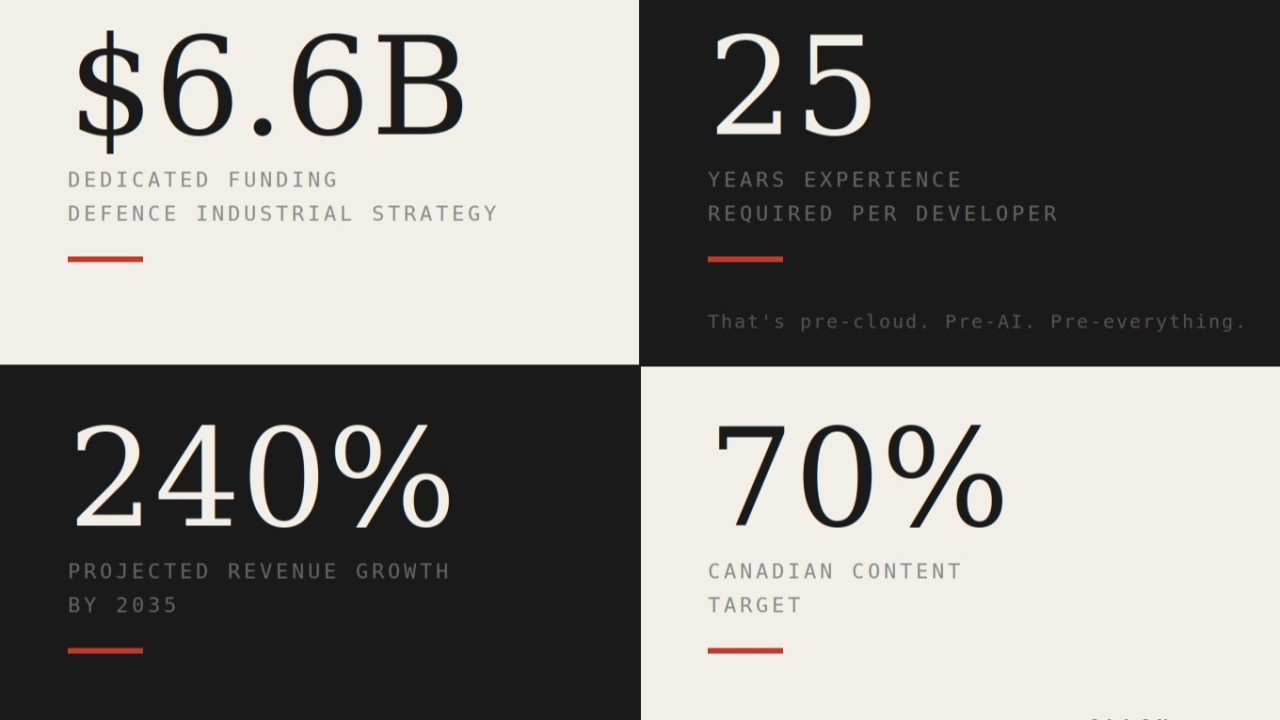
The federal government has released its Defence Industrial Strategy, backed by $6.6 billion in dedicated funding, as part of an $81.8 billion defence investment announced in Budget 2025. The strategy establishes a new "Build-Partner-Buy" framework, targets 70% Canadian content in defence acquisitions, identifies 10 sovereign capabilities from aerospace to autonomous systems, and projects that Canadian defence industry revenues will grow by more than 240% by 2035.
The political will is there. The funding is announced. The framework is detailed. And yet.
We have watched Canada talk itself into bold futures and then quietly hand the contracts to the same names that won them twenty years ago. The "old boys club" is not a conspiracy. It is a procurement culture so deeply entrenched that it does not need to conspire. It simply perpetuates itself. This time, there is a genuine chance to do things differently.
But only if we fight for it.
And that fight starts with being honest about where the system keeps breaking down.
The RFP That Tells You Everything
Want to understand Canada's defence procurement problem in a single data point? Look at the job requirements embedded in many federal defence RFPs, where they routinely demand 25 years of experience per developer.
Twenty-five years.
That is not a qualification. That is a generational filter.
A developer with that experience today graduated in the early 2000s, before the cloud, before containerization, before modern DevSecOps, before the AI revolution reshaping every dimension of military capability. You are not sourcing the best talent. You are sourcing the most familiar talent. And familiarity, in technology, is the enemy of competitive advantage.
The consequence is predictable. Canada continues to lose its best developers to international companies willing to take a chance on talent without a 25-year pedigree. Our IP walks out the door. Our platforms age. And then we spend billions buying updated versions of the same American and European systems we have been buying for decades.
"The problem is not talent, it is process. Canada built a railway from coast to coast in four years in the 1800s. It has taken Ottawa a decade to extend an LRT across the city. The capacity is here. The system is what is broken."— Dan Doran, GCXpo 2025
What the Room Told Me at TiE
At TiE Ottawa's recent event, "From Policy Shifts to Procurement Wins: Strategic Opportunities for Entrepreneurs in a Fast Changing Ecosystem," the room was filled with experienced and, at times, vocally frustrated defence-sector experts. The talent and expertise sitting in that audience were extraordinary.
And yet there was only one person at the front of the room listening.
Laurent Carbonneau of the Council of Canadian Innovators is a thoughtful and capable policy voice. But he cannot be the sole conduit between the knowledge held by Canada's SMEs and the decision makers who actually write RFPs, review applications, and award contracts.
Those decision-makers need to be in the trenches with us, hearing the pitches firsthand and understanding what Canadian companies can actually do when given the opportunity.
But instead, a committee is formed. The committee then spends months deciding what it will study. It gathers all that information. It then writes a report that takes additional months to complete. The report finally reaches decision-makers, who review it for months. By the time any of the feedback reaches those with the authority to act, the content is redundant and the moment has passed.
Decision makers need to stop delegating their listening and start showing up in the rooms where the builders are.
Fear Is the System's Operating Logic
The frustration in that TiE room is not unique to Canada. ONE9's defence accelerator at Capability Labs recently highlighted an uncomfortable truth drawn from analysis of the U.S. defence acquisition system:
"The defence acquisition system is functioning precisely as designed. It produces compliance. It produces documentation. It produces a defensible process. It produces career survivability. Leaders publish memos, give flowery speeches, and issue calls to arms. However, the operational reality shows leaders demand speed while rewarding caution. They praise innovation while protecting the status quo."
Writing in War on the Rocks, put the same truth plainly: the greatest threat to acquisition transformation is not regulation, oversight, or statutory constraint. It is fear. Not fear as an emotion, but fear as architecture. The dominant incentive in the system is fear of audit, protest, scrutiny, and poor performance review, with almost no career consequence for the manager whose project is simply slow.
When visible failure carries career-ending consequences and invisible delay carries almost none, rational actors adapt. And the system perpetuates itself.
Canada would be wise to look at this mirror honestly. If we redesign procurement frameworks without redesigning the incentive structures inside them, we will produce the same outcome with a different name on the cover.
What Experts Are Saying: Reasons for Caution
"The enthusiasm around the Defence Industrial Strategy is real, and some of it is warranted. But important voices in the defence and policy community are raising questions that deserve to be part of this conversation."
Writing in The Hub acknowledged that the strategy is probably strongest in its modernization of DND's approach to innovation. But he raised a concern that should give everyone pause: the gap between what the military wants and what industry can currently provide is significant. Canada's defence establishment is severely undermanned in the roles needed to guide industry toward what the Armed Forces actually need. The 70% domestic content target and the 125,000 new jobs figure are, in his assessment, unworkable in almost any realistic scenario and more likely to lead to creative accounting than effective outcomes.
Retired Senior Military Officer and Strategic Advisor Colin Keiver made a different but equally important point: the Defence Industrial Strategy is missing a clearly articulated National Security Strategy. Without one, it is genuinely difficult to understand what those 125,000 new defence-sector employees will be building.
These are not arguments against ambition. These are arguments for precision.
And precision is exactly what has been missing from Canada's defence procurement culture for a generation.
The New Hubs: A Real Signal, If We Use It
One concrete and genuinely encouraging development: BOREALIS launched a Call for Proposals on February 18, 2026, to provide up to $50 million in non-repayable contributions to establish Defence Innovation Secure Hubs focused on quantum technologies and uncrewed systems. Proposals are open through April 2, 2026, and must involve multidisciplinary teams from at least two eligible Canadian organizations.
This matters because it addresses one of the most persistent gaps in Canadian defence innovation: the absence of secure, mission-oriented environments in which government, industry, and academia can collaborate to move technology beyond the laboratory and toward operational use. A Maritime DISH was already established at COVE in Halifax in November 2025.
The question, as always, is execution. Will these hubs be accessible to SMEs and emerging companies that most need access to defence end users? Or will they replicate the access patterns of the existing procurement culture, where familiarity determines who gets in the room?
The Opportunity: Build It Here, Build It Together
Ottawa has the talent. What it has lacked is a way to compete at scale against the established primes.
The reason the primes keep winning is not that they build better technology. It is that they can absorb the compliance cost of Canada's procurement process.
Smaller firms cannot — not alone.
The paperwork, the certifications, the security requirements, and the sheer administrative weight of a major RFP response are designed, whether intentionally or not, to eliminate anyone without a dedicated BD apparatus behind them.
That is the problem the collaborative model is designed to solve: shared compliance infrastructure, combined capability, no single point of failure.
The Defence Industrial Strategy identifies 10 sovereign capabilities where Canada will prioritize domestic development: Aerospace, Ammunition, Digital Systems, In-Service Support, Personnel Protection, Sensors, Space, Specialized Manufacturing, Training and Simulation, and Uncrewed and Autonomous Systems. These align directly with what Ottawa's technology ecosystem can actually deliver — particularly in cloud-native defence platforms, AI/ML systems, and data sovereignty architecture, where Canadian IP has the most to offer and the most to lose.
Ollon, alongside a select group of Ottawa-based Canadian firms, is building exactly that kind of collaborative ecosystem. The partners are Canadian-owned, security-cleared, and already delivering. What we are forming is not a concept. It is a coordinated capability backed by real work.
As Philippe Lagassé of the Norman Paterson School of International Affairs noted at GCXpo:
"Execution will matter. Ensuring smaller firms, startups, and deep-talent agencies can contribute alongside the primes."
That is precisely what this model is built to do. The goal is not just to win contracts. It is to demonstrate with actual results that this approach outperforms the alternative: faster, under budget, more technologically current, and without the IP leakage that has quietly eroded Canada's competitive advantage for a generation.
What We're Building Toward
As Ann Fitz-Gerald of the Balsillie School of International Affairs said at GCXpo:
"Every delay in decision-making is an opening for foreign adversaries who move faster and with deeper pockets."
The same principle applies to every delay in integrating capable Canadian companies into the defence technology conversation.
Canada's current moment is unlike anything in recent memory. The $6.6 billion is the test. If it flows to the same primes through the same procurement machinery, we will have the same outcome: delayed, over-budget, legacy-dependent systems that serve nobody's long-term interests. If even a meaningful portion flows to collaborative Canadian ecosystems like the one we are building, this could be the moment we look back on as the turning point.
As Michael Smith noted at GCXpo, we do not need the government to solve problems. We need them to catalyze behaviours. The defence hubs emerging in Ottawa are already doing that.
It is time to stop whispering about change and start building it.
If you are a decision-maker in the defence ecosystem and want to understand what this model looks like in practice, I'd welcome the conversation.